
Memories
Keeping your kids' artwork: 7 ideas without the paper pile-up
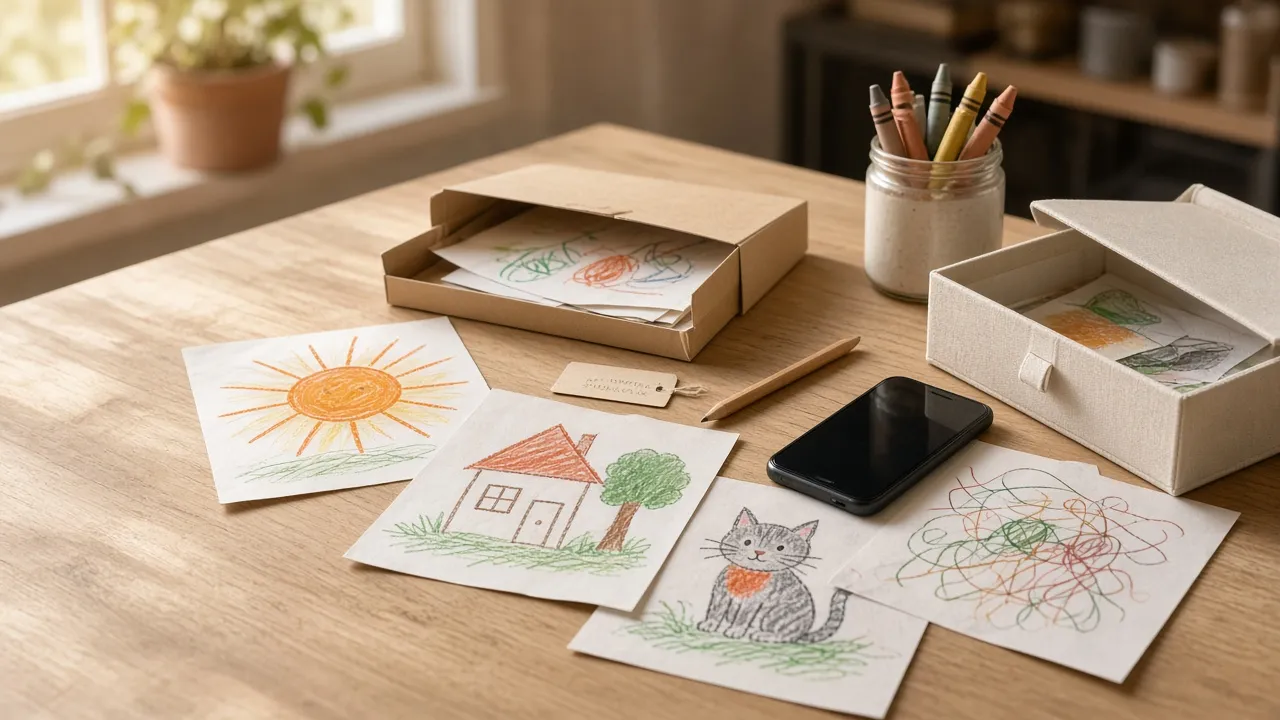
A sun with extremely long rays, a house with a chimney, a cat in an orange scarf and a big tangle of colour that is, according to the artist, “a dragon dancing”: children’s artwork tends to arrive faster than you can find room for it. From nursery, school and the kitchen table, new pages land in bags, drawers and on the fridge every single week.
Keeping all of it is not realistic, and that is perfectly fine. The goal is not to save every sheet, but to hold on to the pieces that mean something to your family. These seven ideas can help, no perfection required.
1. Give new artwork a landing spot
A set place for fresh drawings takes a lot of pressure off: a tray in the hallway, a shelf or a string with a few pegs. Pictures can stay there for a few weeks, get admired and be on show. You do not have to decide straight away what stays. After a while, it often becomes obvious which ones you still love.
2. Choose rather than collect
When the landing spot is full, it is time to sort. A few simple questions help. Does the drawing show something new, like the first person with arms or the first time your child wrote their name? Is there a story behind it? Or do you simply adore it? Those go into the collection. Everything else can go once it has had its moment. Letting a drawing go does not mean it did not matter.
3. Let your child have a say
Children often see their work very differently. The picture you would have passed over might be their favourite, because they were thinking of Grandma while drawing it. Try asking: “Which three pictures should go in your treasure box?” Your child practises choosing and feels their art is taken seriously. And if you cannot agree, a photo makes a good compromise.
4. Photograph what cannot stay
A photo takes up no space and still keeps the colours, the lines and the humour of a picture. Shoot from above in daylight, on a plain surface and without flash. It does not have to be perfectly straight. Big craft projects, chalk drawings on the pavement and toilet roll sculptures can all be saved this way. Some families take a photo of their child holding the artwork, which later shows how small they were at the time.
5. One folder or box per year
For the originals you want to keep, a flat folder or box per child per year is often enough. Write the year and your child’s age on the outside. When it is full, sort once more or take photos. The box sets a gentle limit, so in a few years you will not face a mountain of paper but a small collection you can actually enjoy.
6. Write down the story behind the drawing
On its own, a picture often will not tell you later what it shows. A line like “This is me riding my bike with Dad in the rain” turns a scribble into a memory. Note the date, your child’s age and whatever they told you about it, on the back or next to the photo. Their own words are usually what you will love rereading most.
7. Wish lists and holiday drawings are tiny time capsules
The festive season brings another wave: drawn wish lists, stars, Christmas trees and cards for the grandparents. Wish lists are especially worth keeping, because they show quite precisely what was on your child’s mind that year. Add one to the yearly box each December or take a photo. And maybe a drawing becomes a present: a card, a calendar page or a framed picture for the grandparents.
Keep the picture and the story together
Photos of artwork quickly get lost between holiday snaps and screenshots, while the story stays in your head. In Juno, you can keep a photo of a drawing together with a short note, or add a little video of your child explaining it. If you like, it can later become part of a memory book, where the long-rayed sun and the dancing dragon each get their own page.
A tiny template for the back of the page
- Date and age: …
- What it shows: …
- What my child said about it: …
- Kept because: …
That is all it takes. A good collection is not the most complete one, but the one you will leaf through later and recognise yourselves in: wonky houses, purple dogs and suns shining right to the edge of the page.